Readings Newsletter
Become a Readings Member to make your shopping experience even easier.
Sign in or sign up for free!
You’re not far away from qualifying for FREE standard shipping within Australia
You’ve qualified for FREE standard shipping within Australia
The cart is loading…


Hear Raimond Gaita in conversation with Maria Tumarkin, Michael Heyward, Robert Manne and Sundhya Pahuja as they discuss the Routledge Classics edition of A Common Humanity: Thinking about Love & Truth & Justice.
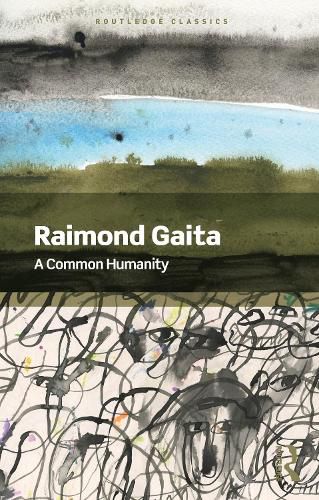
Published first by Text Publishing in 1999, then by Routledge in 2000, A Common Humanity is now available as a Routledge Classic. It explores how the various ethically infected conceptions of humanity inform our understandings of good and evil; of racism; of shame as the expression of collective responsibility, distinct from guilt; of the relevance of ethically different aspects of the Holocaust to conceptions of genocide; of truth as a need of the soul, even in politics; of the role that the concepts of the undiscussable and the unthinkable play in the ethical identity of cultures and individuals, and in arguments over free speech; and of the fragility of the ideal and even the idea of a common humanity as they might be realised in a community of nations.
The Philosophy editor of the Classics series said that he was 'astonished by A Common Humanity’s contemporary relevance'. Nonetheless, to respond to critics, to new conceptual/theoretical developments and to world-changing political and cultural events since Sept 11, 2001, Gaita has written a new preface and afterword, which together total around 18,000 words.
Routledge says of the classic series that 'it contains the very best of Routledge’s publishing over the past century or so [and] makes available in attractive, affordable form some of the most important works of modern times.'
'Raimond Gaita's insights are original and his prose is as eloquent as it is affecting.' The Economist, Books of the Year, 2000
'The trenchant beauty of the discussion, the courage and independence of the mind at work, are a magnificent accomplishment.' Philosophical Books
'This Philosophy for the educated public is philosophy at its most profound.' Jean Curthoys, Australian Book Review
'A wonderful example of how philosophy can still speak without any condescension to the educated reader.' Simon Critchley, Professor of Philosophy, New School for Social Research, New York
Raimond Gaita is Honorary Professorial Fellow at Melbourne Law School and Emeritus Professor of Moral Philosophy, King’s College London. He is a fellow of the Australian Academy of the Humanities. The University of Antwerp awarded him the degree of Doctor Honoris Causa 'for his exceptional contribution to contemporary moral philosophy and for his singular contribution the role of the intellectual in today’s academic world'. His books include Good and Evil: An Absolute Conception, Romulus, My Father (made into a feature film of the same name), The Philosopher’s Dog, After Romulus, Who’s Afraid of International Law (edited with Gerry Simpson) and most recently, edited by Scott Stevens, Justice and Hope: Essays, Lectures and Other Writings.
Maria Tumarkin is a Ukrainian-Jewish-Australian writer and cultural historian. She is the author of four books of ideas – Traumascapes, Courage, Otherland and Axiomatic, winner of the Windham Campell Prize and the Melbourne Prize for literature . She holds a PhD in cultural history and teaches in the creative writing program at the University of Melbourne.
Michael Heyward is the publisher at Text Publishing, a multi-award-winning publishing company in Melbourne. Text publishes Australian and international authors, including Helen Garner, James Islington, Magda Szubanski, Vincenzo Latronico, Amanda Lohrey, Olga Tokarczuk, Kate Grenville, Omar El Akkad, Tim Flannery, Yann Martel, Raimond Gaita, Peter Temple, Carlos Ruiz Zafón, Lloyd Jones, Ta-Nehisi Coates, J.M. Coetzee, Peter Singer, Graeme Simsion, Gail Jones, Barack Obama, and Gerald Murnane.
Robert Manne AO, FASSA is an emeritus professor of politics at La Trobe University. He is the author or editor of some thirty books, including The Petrov Affair, The Culture of Forgetting: Helen Demidenko and the Holocaust, The Mind of the Islamic State, three collections of essays and three Quarterly Essays. His most recent book is A Political Memoir: Intellectual Combat in the Cold War and the Cultural Wars. In 2005 he was voted Australia’s leading public intellectual by his peers. A fellow of the Academy of the Social Sciences in Australia, Manne was appointed an Officer in the General Division of the Order of Australia in 2023.
Sundhya Pahuja is Melbourne Laureate Professor and ARC Kathleen Fitzpatrick Laureate Fellow and Director of the Laureate Program in Global Corporations and International Law. She is known for her work on the encounter between plural forms of international law and the legal, historical, political and economic dimensions of the relations between Global South and North. Her books include the prize-winning book, Decolonising International Law: Development, Economic Growth and the Politics of Universality, Rival Legalities: International Laws of the Cold War with Gerry Simpson and Matthew Craven, and as editor (with Shane Chalmers) The Routledge Handbook of International Law and the Humanities , International Law and the Cold War with Gerry Simpson, Matt Craven and Anna Saunders and The Oxford Handbook on International Law and Development (2023) with Luis Eslava, Ruth Buchanan and Caitlin Murphy.
Free, but bookings are essential.
Please book here.
The Church of All Nations is accessible for people whose mobility is impaired and for wheelchair users, and includes a wheelchair-accessible toilet.
Search our extensive online catalogue.
