Readings Newsletter
Become a Readings Member to make your shopping experience even easier.
Sign in or sign up for free!
You’re not far away from qualifying for FREE standard shipping within Australia
You’ve qualified for FREE standard shipping within Australia
The cart is loading…


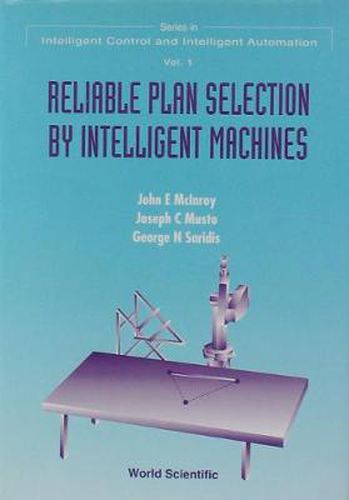
This text derives techniques which allow reliable plans to be automatically selected by intelligent machines. It concentrates on the uncertainty analysis of candidate plans so that a highly reliable candidate may be identified and used. For robotic components, such as a particular vision algorithm for pose estimation or a joint controller, methods are explained for directly calculating the reliability. However, these methods became excessively complex when several components are used together to complete a plan. Consequently, entropy minimization techniques are used to estimate which complex tasks will perform reliably. The book first develops tools for directly calculating the reliability of sub-systems, and methods of using entropy minimization to greatly facilitate the analysis are explained. Since these sub-systems are used together to accomplish complex tasks, the book then explains how complex tasks can be efficiently evaluated.
$9.00 standard shipping within Australia
FREE standard shipping within Australia for orders over $100.00
Express & International shipping calculated at checkout
Stock availability can be subject to change without notice. We recommend calling the shop or contacting our online team to check availability of low stock items. Please see our Shopping Online page for more details.
This text derives techniques which allow reliable plans to be automatically selected by intelligent machines. It concentrates on the uncertainty analysis of candidate plans so that a highly reliable candidate may be identified and used. For robotic components, such as a particular vision algorithm for pose estimation or a joint controller, methods are explained for directly calculating the reliability. However, these methods became excessively complex when several components are used together to complete a plan. Consequently, entropy minimization techniques are used to estimate which complex tasks will perform reliably. The book first develops tools for directly calculating the reliability of sub-systems, and methods of using entropy minimization to greatly facilitate the analysis are explained. Since these sub-systems are used together to accomplish complex tasks, the book then explains how complex tasks can be efficiently evaluated.
Search our extensive online catalogue.
