Readings Newsletter
Become a Readings Member to make your shopping experience even easier.
Sign in or sign up for free!
You’re not far away from qualifying for FREE standard shipping within Australia
You’ve qualified for FREE standard shipping within Australia
The cart is loading…


This title is printed to order. This book may have been self-published. If so, we cannot guarantee the quality of the content. In the main most books will have gone through the editing process however some may not. We therefore suggest that you be aware of this before ordering this book. If in doubt check either the author or publisher’s details as we are unable to accept any returns unless they are faulty. Please contact us if you have any questions.
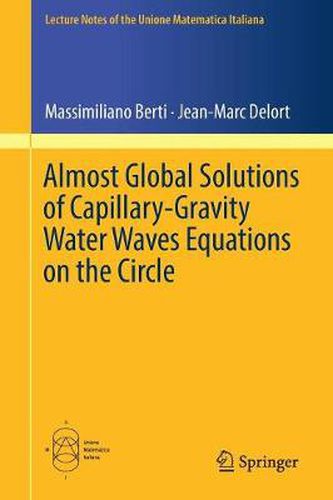
The goal of this monograph is to prove that any solution of the Cauchy problem for the capillary-gravity water waves equations, in one space dimension, with periodic, even in space, small and smooth enough initial data, is almost globally defined in time on Sobolev spaces, provided the gravity-capillarity parameters are taken outside an exceptional subset of zero measure.
In contrast to the many results known for these equations on the real line, with decaying Cauchy data, one cannot make use of dispersive properties of the linear flow. Instead, a normal forms-based procedure is used, eliminating those contributions to the Sobolev energy that are of lower degree of homogeneity in the solution. Since the water waves equations form a quasi-linear system, the usual normal forms approaches would face the well-known problem of losses of derivatives in the unbounded transformations. To overcome this, after a paralinearization of the capillary-gravity water waves equations, we perform several paradifferential reductions to obtain a diagonal system with constant coefficient symbols, up to smoothing remainders. Then we start with a normal form procedure where the small divisors are compensated by the previous paradifferential regularization. The reversible structure of the water waves equations, and the fact that we seek solutions even in space, guarantees a key cancellation which prevents the growth of the Sobolev norms of the solutions.
$9.00 standard shipping within Australia
FREE standard shipping within Australia for orders over $100.00
Express & International shipping calculated at checkout
Stock availability can be subject to change without notice. We recommend calling the shop or contacting our online team to check availability of low stock items. Please see our Shopping Online page for more details.
This title is printed to order. This book may have been self-published. If so, we cannot guarantee the quality of the content. In the main most books will have gone through the editing process however some may not. We therefore suggest that you be aware of this before ordering this book. If in doubt check either the author or publisher’s details as we are unable to accept any returns unless they are faulty. Please contact us if you have any questions.
The goal of this monograph is to prove that any solution of the Cauchy problem for the capillary-gravity water waves equations, in one space dimension, with periodic, even in space, small and smooth enough initial data, is almost globally defined in time on Sobolev spaces, provided the gravity-capillarity parameters are taken outside an exceptional subset of zero measure.
In contrast to the many results known for these equations on the real line, with decaying Cauchy data, one cannot make use of dispersive properties of the linear flow. Instead, a normal forms-based procedure is used, eliminating those contributions to the Sobolev energy that are of lower degree of homogeneity in the solution. Since the water waves equations form a quasi-linear system, the usual normal forms approaches would face the well-known problem of losses of derivatives in the unbounded transformations. To overcome this, after a paralinearization of the capillary-gravity water waves equations, we perform several paradifferential reductions to obtain a diagonal system with constant coefficient symbols, up to smoothing remainders. Then we start with a normal form procedure where the small divisors are compensated by the previous paradifferential regularization. The reversible structure of the water waves equations, and the fact that we seek solutions even in space, guarantees a key cancellation which prevents the growth of the Sobolev norms of the solutions.
Search our extensive online catalogue.
