Readings Newsletter
Become a Readings Member to make your shopping experience even easier.
Sign in or sign up for free!
You’re not far away from qualifying for FREE standard shipping within Australia
You’ve qualified for FREE standard shipping within Australia
The cart is loading…


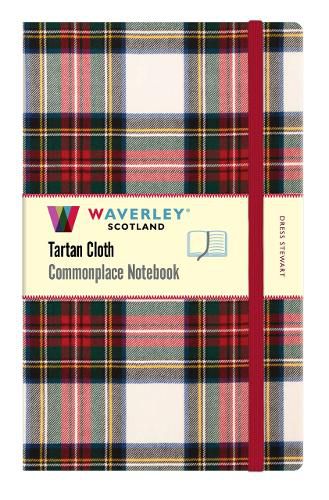
This Large Dress Stewart Tartan Notebook (21x 13cm) with 192 pages from Waverley Scotland has left page blank, right page ruled. Queen Victoria adopted the Dress Stewart tartan and it became wildly popular.The paper is FSC 80 gsm smooth cream paper from sustainable forests. It was genuine British cloth, with elastic closure, ribbon marker, eight perforated end leaves and expandable inner note holder. A removable booklet about the history of the clan tartans, and a bookmark that gives information on the Dress Stewart tartan. It is an arisaid sett of Royal Stewart tartan - a Dress version of the Royal Stewart. Dress tartans often exhanged the key part of the sett with white to achieve a more formal look. These white tartans were known as arisaids (or arasaids) worn as a dress - a long feminine version of the masculine belted plaid.
King George IV's visit in 1822 was pivotal in the tartan story, and Queen Victoria was to bring her own influence on tartan. Queen Victoria was crowned Queen in 1838. The Queen and Prince Albert visited Scotland in 1842, and Queen Victoria was excited by the novels of Sir Walter Scott and in love with the idea of the Highlands. Queen Victoria and Prince Albert fell in love with the Highlands, and purchased Balmoral in 1848, and the land surrounding it. A new castle was completed in 1856 and it has been the Scottish home of the Royal Family ever since. At Balmoral, Prince Albert personally took care of the interior design, where he made great use of tartan. He utilised the red Royal Stewart and green Hunting Stewart tartans for carpets, and the Dress Stewart for curtains and upholstery. The Queen designed the Victoria tartan, and Prince Albert designed the Balmoral tartan which remains the exclusive tartan of the Sovereign of the United Kingdom today. The Dress Stewart tartan was in existence when Victoria became Queen, but became wildly popular after it was adopted by Queen Victoria and the ladies of the royal household at Balmoral. The tartan became very fashionable. By establishing an annual royal residence at Balmoral, the royal family greatly increased the appeal of Scotland as a tourist destination and helped to spread the use of tartan far beyond the borders of Scotland.
The tartan cloth is supplied with the authority of Kinloch Anderson Scotland, holders of Royal Warrants of Appointment and is woven in the United Kingdom. Today Waverley Scotland has over 90 styles across 40 clans and 20 themed tartans.
$9.00 standard shipping within Australia
FREE standard shipping within Australia for orders over $100.00
Express & International shipping calculated at checkout
Stock availability can be subject to change without notice. We recommend calling the shop or contacting our online team to check availability of low stock items. Please see our Shopping Online page for more details.
This Large Dress Stewart Tartan Notebook (21x 13cm) with 192 pages from Waverley Scotland has left page blank, right page ruled. Queen Victoria adopted the Dress Stewart tartan and it became wildly popular.The paper is FSC 80 gsm smooth cream paper from sustainable forests. It was genuine British cloth, with elastic closure, ribbon marker, eight perforated end leaves and expandable inner note holder. A removable booklet about the history of the clan tartans, and a bookmark that gives information on the Dress Stewart tartan. It is an arisaid sett of Royal Stewart tartan - a Dress version of the Royal Stewart. Dress tartans often exhanged the key part of the sett with white to achieve a more formal look. These white tartans were known as arisaids (or arasaids) worn as a dress - a long feminine version of the masculine belted plaid.
King George IV's visit in 1822 was pivotal in the tartan story, and Queen Victoria was to bring her own influence on tartan. Queen Victoria was crowned Queen in 1838. The Queen and Prince Albert visited Scotland in 1842, and Queen Victoria was excited by the novels of Sir Walter Scott and in love with the idea of the Highlands. Queen Victoria and Prince Albert fell in love with the Highlands, and purchased Balmoral in 1848, and the land surrounding it. A new castle was completed in 1856 and it has been the Scottish home of the Royal Family ever since. At Balmoral, Prince Albert personally took care of the interior design, where he made great use of tartan. He utilised the red Royal Stewart and green Hunting Stewart tartans for carpets, and the Dress Stewart for curtains and upholstery. The Queen designed the Victoria tartan, and Prince Albert designed the Balmoral tartan which remains the exclusive tartan of the Sovereign of the United Kingdom today. The Dress Stewart tartan was in existence when Victoria became Queen, but became wildly popular after it was adopted by Queen Victoria and the ladies of the royal household at Balmoral. The tartan became very fashionable. By establishing an annual royal residence at Balmoral, the royal family greatly increased the appeal of Scotland as a tourist destination and helped to spread the use of tartan far beyond the borders of Scotland.
The tartan cloth is supplied with the authority of Kinloch Anderson Scotland, holders of Royal Warrants of Appointment and is woven in the United Kingdom. Today Waverley Scotland has over 90 styles across 40 clans and 20 themed tartans.
Search our extensive online catalogue.
