Readings Newsletter
Become a Readings Member to make your shopping experience even easier.
Sign in or sign up for free!
You’re not far away from qualifying for FREE standard shipping within Australia
You’ve qualified for FREE standard shipping within Australia
The cart is loading…


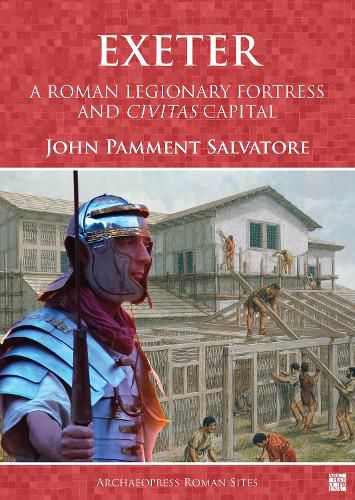
Exeter has long been known as a Roman city, but it was only in 1971 that its origin as a legionary fortress of the mid-first century AD was revealed. That discovery was the result of excavation work undertaken by the first professional archaeological unit to be based in the city. The author was one of those involved and this book explains how innovative archaeological techniques introduced in the 1970s were employed, not only to construct a picture of the legionary fortress, but to demonstrate with some confidence that the 5,000 strong garrison which manned it was the Second Augustan Legion. Whilst at Exeter the legion built its own stone bathhouse. Constructed only around 15-20 years after the Roman invasion in AD 43, it is the earliest known monumental masonry building in the South-West of Britain. Significantly, it was also possible to establish that Exeter became a Roman regional capital around AD 80 after the departure of the legion to Wales. The redundant bathhouse was converted to a basilica (council chamber and administrative centre) for the fledgling city which went on to acquire a circuit of walls by the start of the third century. Exeter continued to flourish as a Roman city on the very western edge of the Roman Empire before its ultimate demise in the late fourth century.
$9.00 standard shipping within Australia
FREE standard shipping within Australia for orders over $100.00
Express & International shipping calculated at checkout
Stock availability can be subject to change without notice. We recommend calling the shop or contacting our online team to check availability of low stock items. Please see our Shopping Online page for more details.
Exeter has long been known as a Roman city, but it was only in 1971 that its origin as a legionary fortress of the mid-first century AD was revealed. That discovery was the result of excavation work undertaken by the first professional archaeological unit to be based in the city. The author was one of those involved and this book explains how innovative archaeological techniques introduced in the 1970s were employed, not only to construct a picture of the legionary fortress, but to demonstrate with some confidence that the 5,000 strong garrison which manned it was the Second Augustan Legion. Whilst at Exeter the legion built its own stone bathhouse. Constructed only around 15-20 years after the Roman invasion in AD 43, it is the earliest known monumental masonry building in the South-West of Britain. Significantly, it was also possible to establish that Exeter became a Roman regional capital around AD 80 after the departure of the legion to Wales. The redundant bathhouse was converted to a basilica (council chamber and administrative centre) for the fledgling city which went on to acquire a circuit of walls by the start of the third century. Exeter continued to flourish as a Roman city on the very western edge of the Roman Empire before its ultimate demise in the late fourth century.
Search our extensive online catalogue.
