Readings Newsletter
Become a Readings Member to make your shopping experience even easier.
Sign in or sign up for free!
You’re not far away from qualifying for FREE standard shipping within Australia
You’ve qualified for FREE standard shipping within Australia
The cart is loading…


This title is printed to order. This book may have been self-published. If so, we cannot guarantee the quality of the content. In the main most books will have gone through the editing process however some may not. We therefore suggest that you be aware of this before ordering this book. If in doubt check either the author or publisher’s details as we are unable to accept any returns unless they are faulty. Please contact us if you have any questions.
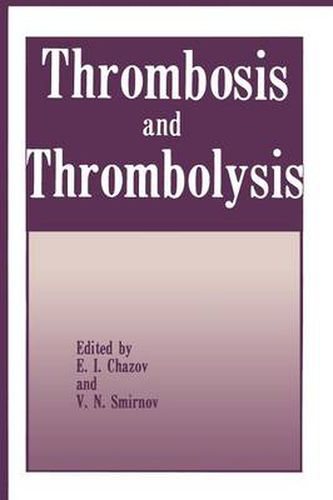
Recent years have seen great strides in research on the pathogenesis of thromboses, unmatched by progress in other branches of hemostasiology. The orthodox concepts of the mechanisms of thrombus formation described by Virchow have come down to us as a classical triad of factors. Now, due to developments in molecular biology, pharmacology, and patho- physiology, they appear in a basically new light. The fruits of modern research, currently being tested or already imple- mented in clinical practice, have opened up the possibility of controlling the hemostatic process and developing effec- tive antithrombotic drugs. Much progress has been achieved in the past years, but much more remains to be achieved in such areas as the patho- genesis of venous and arterial thromboses, early diagnosis, therapy, and control of disorders. Many scientists in the U.S.S.R. are involved in studying these problems. Their data, from years of research carried out in leading laboratories and clinics in the U.S.S.R., are summarized in this monograph. This work is written by experts in various fields of biology and medicine. It deals with new and original con- cepts on the structure and function of the fibrinolytic sys- tem, the role of nonenzymatic fibrinolysis in regulating physiological hemostasis, the heterogeneous and discrete pat- terns of the system regulating blood coagulation, the molecu- lar mechanisms of fibrin polymerization, and the anticoagu- lating effects of fibrinogen/fibrin degradation products.
$9.00 standard shipping within Australia
FREE standard shipping within Australia for orders over $100.00
Express & International shipping calculated at checkout
Stock availability can be subject to change without notice. We recommend calling the shop or contacting our online team to check availability of low stock items. Please see our Shopping Online page for more details.
This title is printed to order. This book may have been self-published. If so, we cannot guarantee the quality of the content. In the main most books will have gone through the editing process however some may not. We therefore suggest that you be aware of this before ordering this book. If in doubt check either the author or publisher’s details as we are unable to accept any returns unless they are faulty. Please contact us if you have any questions.
Recent years have seen great strides in research on the pathogenesis of thromboses, unmatched by progress in other branches of hemostasiology. The orthodox concepts of the mechanisms of thrombus formation described by Virchow have come down to us as a classical triad of factors. Now, due to developments in molecular biology, pharmacology, and patho- physiology, they appear in a basically new light. The fruits of modern research, currently being tested or already imple- mented in clinical practice, have opened up the possibility of controlling the hemostatic process and developing effec- tive antithrombotic drugs. Much progress has been achieved in the past years, but much more remains to be achieved in such areas as the patho- genesis of venous and arterial thromboses, early diagnosis, therapy, and control of disorders. Many scientists in the U.S.S.R. are involved in studying these problems. Their data, from years of research carried out in leading laboratories and clinics in the U.S.S.R., are summarized in this monograph. This work is written by experts in various fields of biology and medicine. It deals with new and original con- cepts on the structure and function of the fibrinolytic sys- tem, the role of nonenzymatic fibrinolysis in regulating physiological hemostasis, the heterogeneous and discrete pat- terns of the system regulating blood coagulation, the molecu- lar mechanisms of fibrin polymerization, and the anticoagu- lating effects of fibrinogen/fibrin degradation products.
Search our extensive online catalogue.
