Readings Newsletter
Become a Readings Member to make your shopping experience even easier.
Sign in or sign up for free!
You’re not far away from qualifying for FREE standard shipping within Australia
You’ve qualified for FREE standard shipping within Australia
The cart is loading…


This title is printed to order. This book may have been self-published. If so, we cannot guarantee the quality of the content. In the main most books will have gone through the editing process however some may not. We therefore suggest that you be aware of this before ordering this book. If in doubt check either the author or publisher’s details as we are unable to accept any returns unless they are faulty. Please contact us if you have any questions.
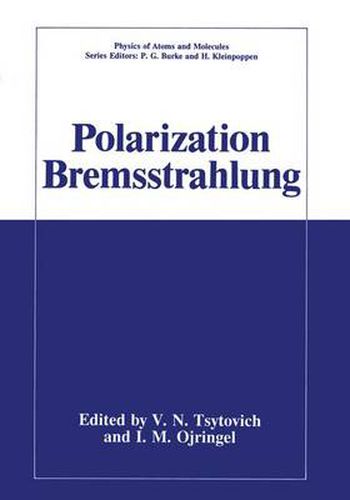
This book was written by a group of authors and provides a systematic dis cussion of questions related to bremsstrahlung in many-particle systems. A number of new results have recently been obtained in this area which require a fundamental revision of the previously existing traditional concepts of bremsstrahlung. This ap plies both to complicated atoms containing a large number of electrons and to the additional bremsstrahlung in a system of many particles forming a medium. In fact, the traditional approach was rigorously applicable only either to isolated structureless particles (e. g. , to the emission of an electron on a proton) or to par ticles radiating in the limit of extremely high frequencies. Polarization effects (either polarization of an atom itself by an incident particle or polarization of the medium surrounding an atomic particle) have a significant effect in the practically important optical and x-ray frequency ranges and sometimes even predominate. The first effect has come to be known as polarization atomic (or dynamic) bremsstrahlung and the second, as polarization transition bremsstrahlung. The au thors of this book use a single term: polarization bremsstrahlung. It seems that, in contrast to earlier ideas on the subject, bremsstrahlung during collisions of heavy incident particles with atoms is by no means small and is entirely caused by polar ization effects.
$9.00 standard shipping within Australia
FREE standard shipping within Australia for orders over $100.00
Express & International shipping calculated at checkout
Stock availability can be subject to change without notice. We recommend calling the shop or contacting our online team to check availability of low stock items. Please see our Shopping Online page for more details.
This title is printed to order. This book may have been self-published. If so, we cannot guarantee the quality of the content. In the main most books will have gone through the editing process however some may not. We therefore suggest that you be aware of this before ordering this book. If in doubt check either the author or publisher’s details as we are unable to accept any returns unless they are faulty. Please contact us if you have any questions.
This book was written by a group of authors and provides a systematic dis cussion of questions related to bremsstrahlung in many-particle systems. A number of new results have recently been obtained in this area which require a fundamental revision of the previously existing traditional concepts of bremsstrahlung. This ap plies both to complicated atoms containing a large number of electrons and to the additional bremsstrahlung in a system of many particles forming a medium. In fact, the traditional approach was rigorously applicable only either to isolated structureless particles (e. g. , to the emission of an electron on a proton) or to par ticles radiating in the limit of extremely high frequencies. Polarization effects (either polarization of an atom itself by an incident particle or polarization of the medium surrounding an atomic particle) have a significant effect in the practically important optical and x-ray frequency ranges and sometimes even predominate. The first effect has come to be known as polarization atomic (or dynamic) bremsstrahlung and the second, as polarization transition bremsstrahlung. The au thors of this book use a single term: polarization bremsstrahlung. It seems that, in contrast to earlier ideas on the subject, bremsstrahlung during collisions of heavy incident particles with atoms is by no means small and is entirely caused by polar ization effects.
Search our extensive online catalogue.
