Readings Newsletter
Become a Readings Member to make your shopping experience even easier.
Sign in or sign up for free!
You’re not far away from qualifying for FREE standard shipping within Australia
You’ve qualified for FREE standard shipping within Australia
The cart is loading…


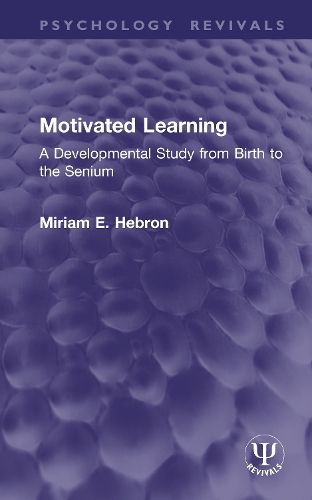
Originally published in 1966, Dr Hebron provides a comprehensive account in this book of the main theories of motivation and learning as applicable to each phase of the human life cycle at the time. She synthesises current theories by placing each within the context of the developmental phase for which it has the greatest significance; and she provides 350 supporting references.
Each stage of human development is discussed separately, through infancy, early childhood, the transitional intuitive phase, middle childhood, and adolescence, to maturity and senility. Two chapters are devoted to adolescence, and there is interesting material on the gifted adolescent. The chapter on physiology describes with clarity the changes in physical structure and function which ensue as children enter into their cultural heritage, as adults become socially involved, and as the elderly undergo gradual disengagement.
The book was addressed to the more advanced student preparing for the newly instituted degrees in education, to post-graduates in education, and to students in their third year of degree courses in psychology and sociology. Today it can be read in its historical context.
$9.00 standard shipping within Australia
FREE standard shipping within Australia for orders over $100.00
Express & International shipping calculated at checkout
Stock availability can be subject to change without notice. We recommend calling the shop or contacting our online team to check availability of low stock items. Please see our Shopping Online page for more details.
Originally published in 1966, Dr Hebron provides a comprehensive account in this book of the main theories of motivation and learning as applicable to each phase of the human life cycle at the time. She synthesises current theories by placing each within the context of the developmental phase for which it has the greatest significance; and she provides 350 supporting references.
Each stage of human development is discussed separately, through infancy, early childhood, the transitional intuitive phase, middle childhood, and adolescence, to maturity and senility. Two chapters are devoted to adolescence, and there is interesting material on the gifted adolescent. The chapter on physiology describes with clarity the changes in physical structure and function which ensue as children enter into their cultural heritage, as adults become socially involved, and as the elderly undergo gradual disengagement.
The book was addressed to the more advanced student preparing for the newly instituted degrees in education, to post-graduates in education, and to students in their third year of degree courses in psychology and sociology. Today it can be read in its historical context.
Search our extensive online catalogue.
