Readings Newsletter
Become a Readings Member to make your shopping experience even easier.
Sign in or sign up for free!
You’re not far away from qualifying for FREE standard shipping within Australia
You’ve qualified for FREE standard shipping within Australia
The cart is loading…


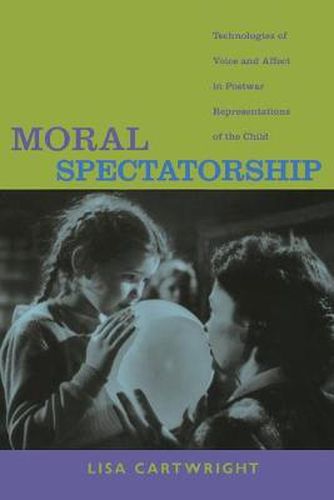
In Moral Spectatorship, Lisa Cartwright rethinks the politics of spectatorship in film studies. At the same time, she offers a new theory of the human subject that takes into account affective relationships and technologies that facilitate human agency. Seeking to expand concepts of representation beyond the visual, Cartwright develops her theory through interpretations of two contexts in which adult caregivers help bring children to voice. She considers mid-twentieth-century social-problem melodramas about deaf and nonverbal girls and young women, including Johnny Belinda, Thursday’s Children, The Miracle Worker, and Children of a Lesser God. Cartwright also analyzes the controversies surrounding facilitated communication, a technological practice in which caregivers help children with communication disorders achieve voice through writing facilitated by computers. This practice has inspired contempt among many professional and lay people who charge that the facilitator can manipulate the child’s speech.For more than two decades, film theory has been dominated by a model of identification tacitly based on the idea of feeling what the other feels or of imagining oneself to be the other. Cartwright argues that the custodial relationships underlying both the melodramas and facilitated speech involve a different kind of identification, which she calls empathetic. In empathetic identification, the subject does not necessarily feel the other’s feelings or imagine him or herself in the other’s place; rather he or she recognizes and enables the otherness of the other. Building on the theories of affect developed by the French psychoanalyst Andre Green and the American cognitive psychologist Silvan Tomkins, Cartwright develops a theory of spectatorship based on empathetic identification.
$9.00 standard shipping within Australia
FREE standard shipping within Australia for orders over $100.00
Express & International shipping calculated at checkout
Stock availability can be subject to change without notice. We recommend calling the shop or contacting our online team to check availability of low stock items. Please see our Shopping Online page for more details.
In Moral Spectatorship, Lisa Cartwright rethinks the politics of spectatorship in film studies. At the same time, she offers a new theory of the human subject that takes into account affective relationships and technologies that facilitate human agency. Seeking to expand concepts of representation beyond the visual, Cartwright develops her theory through interpretations of two contexts in which adult caregivers help bring children to voice. She considers mid-twentieth-century social-problem melodramas about deaf and nonverbal girls and young women, including Johnny Belinda, Thursday’s Children, The Miracle Worker, and Children of a Lesser God. Cartwright also analyzes the controversies surrounding facilitated communication, a technological practice in which caregivers help children with communication disorders achieve voice through writing facilitated by computers. This practice has inspired contempt among many professional and lay people who charge that the facilitator can manipulate the child’s speech.For more than two decades, film theory has been dominated by a model of identification tacitly based on the idea of feeling what the other feels or of imagining oneself to be the other. Cartwright argues that the custodial relationships underlying both the melodramas and facilitated speech involve a different kind of identification, which she calls empathetic. In empathetic identification, the subject does not necessarily feel the other’s feelings or imagine him or herself in the other’s place; rather he or she recognizes and enables the otherness of the other. Building on the theories of affect developed by the French psychoanalyst Andre Green and the American cognitive psychologist Silvan Tomkins, Cartwright develops a theory of spectatorship based on empathetic identification.
Search our extensive online catalogue.
