Readings Newsletter
Become a Readings Member to make your shopping experience even easier.
Sign in or sign up for free!
You’re not far away from qualifying for FREE standard shipping within Australia
You’ve qualified for FREE standard shipping within Australia
The cart is loading…


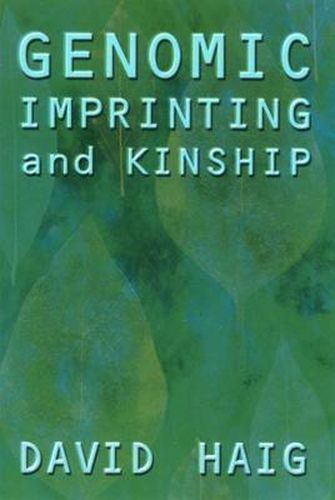
Until twenty years ago we had no idea which of our genes came from our father and which came from our mother. We took it for granted that our genes expressed themselves identically and that there was a 50/50 chance that they came from either parent. We also assumed that they worked in cooperation with each other. The biggest breakthrough in genetics in the past two decades has been the discovery of genomic imprinting, which allows us to trace genes to the parent of origin. David Haig has been at the forefront of theorizing these developments arguing that these paternally and maternally active genes comprising less than one percent of our total gene count are far from being cooperative, and have in fact been shown to be in competition with one another. If Haig’s theory is correct, imprinted genes provide an extraordinary example of within-individual conflict, which is one of the most surprising developments in evolutionary biology in recent years. Examples like this are shaking up our fundamental ideas of what it means to be an individual. This collection of Haig’s papers provides a unique comprehensive overview of what is known. Each paper is followed by a commentary that links it to the others, provides background as needed, and brings readers up-to-date on developments that occurred after the paper’s original publication. Because genomic imprinting raises questions across various fields in the life sciences, including evolutionary biology and developmental genetics, Haig’s work is scattered through the literature to an unusual degree, and has never been collected in one volume.
$9.00 standard shipping within Australia
FREE standard shipping within Australia for orders over $100.00
Express & International shipping calculated at checkout
Stock availability can be subject to change without notice. We recommend calling the shop or contacting our online team to check availability of low stock items. Please see our Shopping Online page for more details.
Until twenty years ago we had no idea which of our genes came from our father and which came from our mother. We took it for granted that our genes expressed themselves identically and that there was a 50/50 chance that they came from either parent. We also assumed that they worked in cooperation with each other. The biggest breakthrough in genetics in the past two decades has been the discovery of genomic imprinting, which allows us to trace genes to the parent of origin. David Haig has been at the forefront of theorizing these developments arguing that these paternally and maternally active genes comprising less than one percent of our total gene count are far from being cooperative, and have in fact been shown to be in competition with one another. If Haig’s theory is correct, imprinted genes provide an extraordinary example of within-individual conflict, which is one of the most surprising developments in evolutionary biology in recent years. Examples like this are shaking up our fundamental ideas of what it means to be an individual. This collection of Haig’s papers provides a unique comprehensive overview of what is known. Each paper is followed by a commentary that links it to the others, provides background as needed, and brings readers up-to-date on developments that occurred after the paper’s original publication. Because genomic imprinting raises questions across various fields in the life sciences, including evolutionary biology and developmental genetics, Haig’s work is scattered through the literature to an unusual degree, and has never been collected in one volume.
Search our extensive online catalogue.
