Readings Newsletter
Become a Readings Member to make your shopping experience even easier.
Sign in or sign up for free!
You’re not far away from qualifying for FREE standard shipping within Australia
You’ve qualified for FREE standard shipping within Australia
The cart is loading…


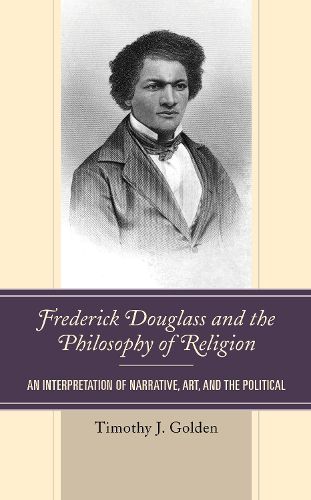
Frederick Douglass and the Philosophy of Religion: An Interpretation of Narrative, Art, and Politics addresses Douglass’s narrative method and the reformed epistemology of analytic theism within the context of incarnational theology. Timothy J. Golden argues that in this context, Douglass’s use of narrative maintains a robust moral, social, and political engagement-and thus a closer connection to an authentic Christian theology-in a way that analytic theism does not. To show this contrast, Golden presents existential and phenomenological interpretations of Douglass, reading him with Kierkegaard, Kafka, and Levinas. Golden also interprets Douglass’s use of moral suasion with Kant’s moments of aesthetic judgment and his account of judgment as a mediating faculty between the understanding and reason. Golden concludes the book with reflection on how Douglass’s incarnational theology connects to his future philosophical and theological work, work that understands consciousness (subjectivity) as saturated in time understood as history. The resulting understanding of consciousness provides tools to overcome abstraction not only in social and political philosophy, Christianity, and philosophical theology, but also in gender studies.
$9.00 standard shipping within Australia
FREE standard shipping within Australia for orders over $100.00
Express & International shipping calculated at checkout
Stock availability can be subject to change without notice. We recommend calling the shop or contacting our online team to check availability of low stock items. Please see our Shopping Online page for more details.
Frederick Douglass and the Philosophy of Religion: An Interpretation of Narrative, Art, and Politics addresses Douglass’s narrative method and the reformed epistemology of analytic theism within the context of incarnational theology. Timothy J. Golden argues that in this context, Douglass’s use of narrative maintains a robust moral, social, and political engagement-and thus a closer connection to an authentic Christian theology-in a way that analytic theism does not. To show this contrast, Golden presents existential and phenomenological interpretations of Douglass, reading him with Kierkegaard, Kafka, and Levinas. Golden also interprets Douglass’s use of moral suasion with Kant’s moments of aesthetic judgment and his account of judgment as a mediating faculty between the understanding and reason. Golden concludes the book with reflection on how Douglass’s incarnational theology connects to his future philosophical and theological work, work that understands consciousness (subjectivity) as saturated in time understood as history. The resulting understanding of consciousness provides tools to overcome abstraction not only in social and political philosophy, Christianity, and philosophical theology, but also in gender studies.
Search our extensive online catalogue.
