Readings Newsletter
Become a Readings Member to make your shopping experience even easier.
Sign in or sign up for free!
You’re not far away from qualifying for FREE standard shipping within Australia
You’ve qualified for FREE standard shipping within Australia
The cart is loading…


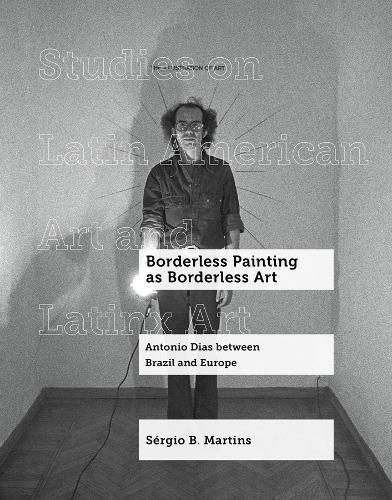
The artwork of Antonio Dias (1944-2018) uniquely captures the interwoven histories of Brazilian postwar realism and of European conceptualism in the 1960s and 1970s. By tracking Dias's ever-shifting works and circulation as he moved from Rio de Janeiro to Paris, and then to Milan, Borderless Painting as Borderless Art provides the first in-depth study of the artist.
Sergio B. Martins uses Dias's trajectory as a lens to explore different approaches to avant-gardism and its crisis in Brazil, France, and northern Italy, weaving in the perspectives of figures such as Helio Oiticica, Harald Szeemann, Pierre Restany, Giulio Paolini, and Tommaso Trini, as well as the Fluxus movement. The book ultimately argues that Dias pitted his formation in a semi-peripheral avant-garde against a post-avant-gardist milieu where commodity culture and market relations were far more pervasive and determinant vis-a-vis the arts scene.
$9.00 standard shipping within Australia
FREE standard shipping within Australia for orders over $100.00
Express & International shipping calculated at checkout
Stock availability can be subject to change without notice. We recommend calling the shop or contacting our online team to check availability of low stock items. Please see our Shopping Online page for more details.
The artwork of Antonio Dias (1944-2018) uniquely captures the interwoven histories of Brazilian postwar realism and of European conceptualism in the 1960s and 1970s. By tracking Dias's ever-shifting works and circulation as he moved from Rio de Janeiro to Paris, and then to Milan, Borderless Painting as Borderless Art provides the first in-depth study of the artist.
Sergio B. Martins uses Dias's trajectory as a lens to explore different approaches to avant-gardism and its crisis in Brazil, France, and northern Italy, weaving in the perspectives of figures such as Helio Oiticica, Harald Szeemann, Pierre Restany, Giulio Paolini, and Tommaso Trini, as well as the Fluxus movement. The book ultimately argues that Dias pitted his formation in a semi-peripheral avant-garde against a post-avant-gardist milieu where commodity culture and market relations were far more pervasive and determinant vis-a-vis the arts scene.
Search our extensive online catalogue.
