Readings Newsletter
Become a Readings Member to make your shopping experience even easier.
Sign in or sign up for free!
You’re not far away from qualifying for FREE standard shipping within Australia
You’ve qualified for FREE standard shipping within Australia
The cart is loading…


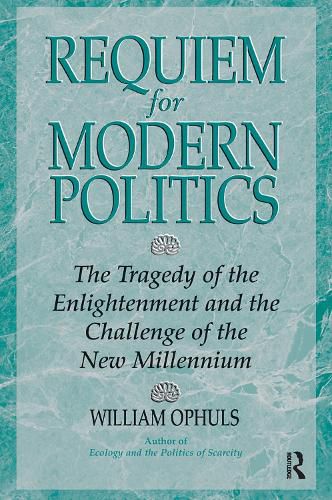
This long-promised sequel to Ophuls’s influential and controversial classic Ecology and the Politics of Scarcity is an equally provocative critique of the liberal philosophy of government. Ophuls contends that the modern political paradigm-that is, the body of political concepts and beliefs bequeathed to us by the Enlightenment-is no longer intellectually tenable or practically viable. Our attempt to live individualistically, hedonistically, and rationally has failed utterly, causing a comprehensive crisis that is at once political, military, economic, ecological, ethical, psychological, and spiritual. Liberal politics has abandoned virtue, rejected community, and flouted nature, thereby becoming the author of its own demise. By exposing the intrinsically contradictory and self-destructive character of Hobbesian political systems, Ophuls subverts our conventional wisdom at every turn. Indeed, his impassioned text reads more like a Greek tragedy than a conventional political argument. He critiques feminism, multiculturalism, the welfare state, and a host of other liberal shibboleths-but Ophuls is not yet another neoconservative. The aim of his thesis is far more radical and progressive, offering a political vision that entirely transcends the categories of liberal thought. His is a Thoreauvian vision of a politics of consciousness rooted in ecology as the moral and intellectual basis for governance in the twenty-first century. Ophuls holds that a polity based on a renewed erotic connection with nature offers a genuine solution to this crisis of contemporary civilization and that only within such a polity will it be possible to fulfill the worthy liberal goal of individual self-development. Ophuls’s work will interest and challenge a wide spectrum of readers, though it will not necessarily be well liked or easily accepted. No one will put down this book with his or her settled convictions about American culture intact, nor will readers ever again take modern civilization and its survival for granted.
$9.00 standard shipping within Australia
FREE standard shipping within Australia for orders over $100.00
Express & International shipping calculated at checkout
Stock availability can be subject to change without notice. We recommend calling the shop or contacting our online team to check availability of low stock items. Please see our Shopping Online page for more details.
This long-promised sequel to Ophuls’s influential and controversial classic Ecology and the Politics of Scarcity is an equally provocative critique of the liberal philosophy of government. Ophuls contends that the modern political paradigm-that is, the body of political concepts and beliefs bequeathed to us by the Enlightenment-is no longer intellectually tenable or practically viable. Our attempt to live individualistically, hedonistically, and rationally has failed utterly, causing a comprehensive crisis that is at once political, military, economic, ecological, ethical, psychological, and spiritual. Liberal politics has abandoned virtue, rejected community, and flouted nature, thereby becoming the author of its own demise. By exposing the intrinsically contradictory and self-destructive character of Hobbesian political systems, Ophuls subverts our conventional wisdom at every turn. Indeed, his impassioned text reads more like a Greek tragedy than a conventional political argument. He critiques feminism, multiculturalism, the welfare state, and a host of other liberal shibboleths-but Ophuls is not yet another neoconservative. The aim of his thesis is far more radical and progressive, offering a political vision that entirely transcends the categories of liberal thought. His is a Thoreauvian vision of a politics of consciousness rooted in ecology as the moral and intellectual basis for governance in the twenty-first century. Ophuls holds that a polity based on a renewed erotic connection with nature offers a genuine solution to this crisis of contemporary civilization and that only within such a polity will it be possible to fulfill the worthy liberal goal of individual self-development. Ophuls’s work will interest and challenge a wide spectrum of readers, though it will not necessarily be well liked or easily accepted. No one will put down this book with his or her settled convictions about American culture intact, nor will readers ever again take modern civilization and its survival for granted.
Search our extensive online catalogue.
