Readings Newsletter
Become a Readings Member to make your shopping experience even easier.
Sign in or sign up for free!
You’re not far away from qualifying for FREE standard shipping within Australia
You’ve qualified for FREE standard shipping within Australia
The cart is loading…


This title is printed to order. This book may have been self-published. If so, we cannot guarantee the quality of the content. In the main most books will have gone through the editing process however some may not. We therefore suggest that you be aware of this before ordering this book. If in doubt check either the author or publisher’s details as we are unable to accept any returns unless they are faulty. Please contact us if you have any questions.
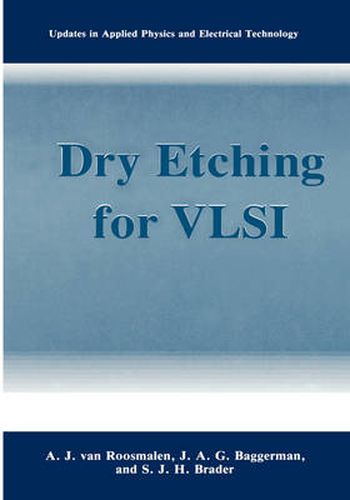
This book has been written as part of a series of scientific books being published by Plenum Press. The scope of the series is to review a chosen topic in each volume. To supplement this information, the abstracts to the most important references cited in the text are reprinted, thus allowing the reader to find in-depth material without having to refer to many additional publications. This volume is dedicated to the field of dry (plasma) etching, as applied in silicon semiconductor processing. Although a number of books have appeared dealing with this area of physics and chemistry, these all deal with parts of the field. This book is unique in that it gives a compact, yet complete, in-depth overview of fundamentals, systems, processes, tools, and applications of etching with gas plasmas for VLSI. Examples are given throughout the fundamental sections, in order to give the reader a better insight in the meaning and magnitude of the many parameters relevant to dry etching. Electrical engineering concepts are emphasized to explain the pros and cons of reactor concepts and excitation frequency ranges. In the description of practical applications, extensive use is made of cross-referencing between processes and materials, as well as theory and practice. It is thus intended to provide a total model for understanding dry etching. The book has been written such that no previous knowledge of the subject is required. It is intended as a review of all aspects of dry etching for silicon semiconductor processing.
$9.00 standard shipping within Australia
FREE standard shipping within Australia for orders over $100.00
Express & International shipping calculated at checkout
Stock availability can be subject to change without notice. We recommend calling the shop or contacting our online team to check availability of low stock items. Please see our Shopping Online page for more details.
This title is printed to order. This book may have been self-published. If so, we cannot guarantee the quality of the content. In the main most books will have gone through the editing process however some may not. We therefore suggest that you be aware of this before ordering this book. If in doubt check either the author or publisher’s details as we are unable to accept any returns unless they are faulty. Please contact us if you have any questions.
This book has been written as part of a series of scientific books being published by Plenum Press. The scope of the series is to review a chosen topic in each volume. To supplement this information, the abstracts to the most important references cited in the text are reprinted, thus allowing the reader to find in-depth material without having to refer to many additional publications. This volume is dedicated to the field of dry (plasma) etching, as applied in silicon semiconductor processing. Although a number of books have appeared dealing with this area of physics and chemistry, these all deal with parts of the field. This book is unique in that it gives a compact, yet complete, in-depth overview of fundamentals, systems, processes, tools, and applications of etching with gas plasmas for VLSI. Examples are given throughout the fundamental sections, in order to give the reader a better insight in the meaning and magnitude of the many parameters relevant to dry etching. Electrical engineering concepts are emphasized to explain the pros and cons of reactor concepts and excitation frequency ranges. In the description of practical applications, extensive use is made of cross-referencing between processes and materials, as well as theory and practice. It is thus intended to provide a total model for understanding dry etching. The book has been written such that no previous knowledge of the subject is required. It is intended as a review of all aspects of dry etching for silicon semiconductor processing.
Search our extensive online catalogue.
