
$27.95 (Paperback book / Scribe Publications / ISBN:9781921372209)
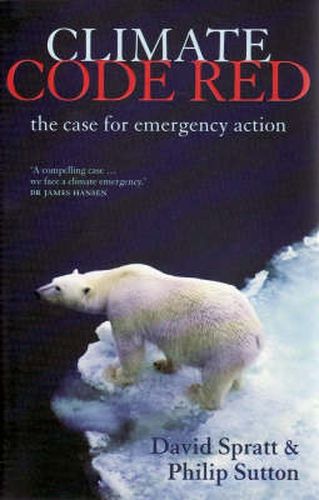
Climate Code Red: The Case for Emergency Action
In this meticulously documented call-to-action, David Spratt and Philip Sutton reveal extensive scientific evidence that the global warming crisis is far worse than official reports and national governments have indicated — and that we’re almost at the point of no return.
Serious climate-change impacts are already happening, more rapidly and at lower global temperature-increases than projected. As the USA’s most eminent climate scientist, James Hansen, told 15,000 of his colleagues at a conference in December 2007, significant ‘climate tipping’ points have already been passed. These include large ice-sheet disintegration, significant sea-level rises of up to five metres this century, and devastating species loss. The Arctic will soon be free of summer sea-ice — a century ahead of projections by the Intergovernmental Panel on Climate Change projections — and the Greenland ice sheet is in imminent danger.
The tipping point for the loss of the Arctic sea-ice was around two decades ago, when temperatures were about 0.3°C lower than at present. Climate Code Red shows that further temperature increases of 2 degrees are effectively already in the system, and even a temperature cap of 2–2.4°C, which is proposed within the United Nations framework — and is far below what most governments are prepared to aim for — would take the planet’s climate beyond the temperature range of the last million years.
David Spratt and and Philip Sutton show that the unofficial, real projected speed of climate change— with temperature increases greater than 0.3°C per decade, and the consequent rapid shifting of climatic zones — will, if maintained, likely result in most ecosystems failing to adapt, causing the extinction of many species. The oceans will become more acidic, endangering much marine life.
This means that the dangers we all face are already much greater than the headlines indicate. According to climate scientists such as James Hansen, it is no longer a case of how much more we can ‘safely’ emit, but whether we can quickly enough stop emissions and produce a deliberate cooling before the earth’s climate system reaches a runaway trajectory that is beyond any hope of human restoration.
These imperatives are incompatible with ‘politics as usual’ and ‘business as usual’. Climate Code Red argues that there is an urgent need for all of us to recognise that we face a sustainability emergency — which requires a clear break from the politics of failure-inducing compromise. Even scientifically moderate goals (such as reducing emissions by 25–40 per cent below 1990 levels by 2020) now require immoderate rates of technical and social change that are only achievable by shifting formally to an emergency footing.
Spratt and Sutton believe that we now need to think the unthinkable, because the case for emergency action is not so much a radical idea as an indispensable course we must embark upon if we are to return to a safe-climate planet.
The Prize for Science Writing
The Rise Of Animals: Evolution And Diversification Of The Kingdom Animalia
$119.00 (Hardcover book / Johns Hopkins )
Among the major events in evolutionary history, few rival in importance the appearance of animals. The Rise of Animals—a significant reference providing a comprehensive synthesis of the early radiation of the animal king... More »
Climate Code Red: The Case for Emergency Action
$27.95 (Paperback book / Scribe Publications )
In this meticulously documented call-to-action, David Spratt and Philip Sutton reveal extensive scientific evidence that the global warming crisis is far worse than official reports and national governments have indicate... More »
Pasteur's Gambit: Louis Pasteur The Australasian Rabbit Plagueand A Ten Million Dollar Prize
$34.95 (Trade paperback / Vintage )
In 1887, the desperate NSW Government of Sir Henry Parkes advertised an international competition for a biological cure for the rabbit plague then ravaging the farms of Australia and New Zealand. The competition, with a ... More »